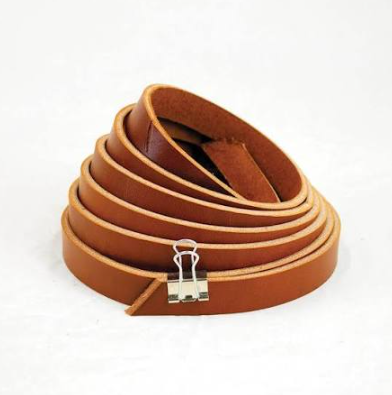
A good strap changes how a bag feels to carry. It decides whether the bag sits comfortably on your shoulder, whether it slips, whether it suits the occasion, and how long the whole piece lasts. Yet the strap is often an afterthought, chosen quickly while attention goes to the bag itself. Taking a little time over the choice pays off, because the right strap in the right leather can transform a bag you already own, while the wrong one can make even a beautiful bag awkward to use.
Why Leather Works So Well
Leather has been used for carrying straps for centuries, and the reasons have not changed. It is strong for its weight, it flexes without snapping, and it develops a richer appearance with use rather than looking worn out. A well-made leather strap moulds slightly to the shoulder over time, becoming more comfortable the more you carry it.
Not all leather is the same, though. Full-grain leather, taken from the top layer of the hide, is the most durable and ages the best, developing a patina that many people value. Top-grain leather is slightly thinner and more uniform in appearance, and it is a good choice when you want a smooth, consistent finish. Corrected or bonded leathers are cheaper, but they are less durable and less pleasant to handle, and they tend to crack or peel at the edges after extended use.
The tanning method matters too. Vegetable-tanned leather is firmed and coloured using plant-based tannins, and it ages gracefully, darkening slightly with exposure to light and handling. Chrome-tanned leather is softer and more resistant to water, which suits everyday use in changeable weather. Neither is better in every situation; the choice depends on whether you value character and ageing, or softness and practicality.
See also: Fix It or Forget It? A Homeowner’s Guide to Renovation Decisions
Getting the Length and Width Right
Length is the first practical decision. A strap that is too short forces the bag high under your arm, while one that is too long lets it swing and bump against your hip. For a shoulder carry, the bag should rest comfortably at your hip, with the strap sitting flat and not digging in. For cross-body wear, the bag should sit at the opposite hip, leaving your hands free and the weight spread across your torso.
Adjustable straps are the safest choice if you are unsure, because they let you change the drop to suit different outfits and occasions. Look for an adjustment mechanism that stays in place once set; a buckle that slips gradually is a common frustration, and it usually means the holes are spaced too far apart or the buckle is poorly made. Fixed-length straps can look cleaner, but only buy one if you have measured carefully against a strap you already like.
Width affects comfort more than most people expect. When you are choosing a leather bag strap for everyday use, width is one of the first things to compare, because it decides how the weight sits on your shoulder. A narrow strap concentrates the weight of the bag on a small area, which becomes uncomfortable quickly if the bag is heavy. A wider strap spreads the load and is kinder on the shoulder, particularly for a bag carried all day. As a rough guide, a strap around two centimetres wide suits a light bag, while a heavier bag benefits from three centimetres or more. Very wide straps can look out of proportion on a small bag, so balance comfort against appearance.
Matching a Strap to Your Bag and Your Life
Think about how and where you actually use the bag. A slim, elegant strap suits a structured bag carried to work or formal occasions, while a wider, more robust strap is better for a bag that travels, carries a laptop, or is used on long days out. Colour is part of the decision: black and dark brown are versatile and forgiving, tan develops character with age, and a contrasting colour can refresh a plain bag without replacing it.
If you are replacing a strap on a bag you already own, bring the bag with you when shopping, or measure the existing strap carefully, including the width of the fittings. If you are buying a strap for a new bag, consider buying from the same maker, since their fittings are more likely to match. When you want to see the range of colours, widths and fittings available in one place, a dedicated collection is the easiest way to compare, and browsing one collection shows how much variety exists even within a single category.
Try the strap on the bag before committing, and walk around with it loaded as you would normally carry it. A strap that looks right in a shop can feel wrong after twenty minutes, and a short test with a realistic load is the most reliable way to judge comfort.
Frequently Asked Questions
1. How do I know what length of strap to choose?
Measure a strap you already find comfortable, from one attachment point to the other, and use that as your starting point. For shoulder wear the bag should sit at your hip, and for cross-body wear it should rest at the opposite hip. An adjustable option is the safest choice if you are between sizes or want to switch between styles.
2. Will a leather strap stretch over time?
Good quality leather stretches very slightly as it breaks in, then settles. Significant stretching usually means the strap is overloaded or the leather is too thin for the weight it carries. Choosing a strap of appropriate width and thickness for your bag, and avoiding routine overloading, keeps stretching to a minimum.
3. Can I use the same strap on different bags?
Yes, provided the clasps fit the attachment rings on each bag and the width suits the size of the bag. Swivel clasps make this easier, because they accommodate different ring orientations. Many people keep one or two versatile straps in neutral colours and move them between bags as needed.
Conclusion
Choosing a strap is a small decision that affects how a bag feels every time you pick it up. Pay attention to the quality of the leather, the length and width, the hardware, and how the strap fits your daily routine, and you will end up with something that is comfortable, durable and suited to the bag it carries.